All News & Articles
Almost exactly 18 months ago we released Tailwind CSS v1.0, which signalled a commitment to stability while continuing to push the boundaries with exciting new features in every minor release.

We’re excited to release .NET 5.0 today and for you to start using it. It’s a major release — including C# 9 and F# 5 — with a broad set of new features and compelling improvements. It’s already in active use by teams at Microsoft and other companies, in production and for performance testing.
We are excited to introduce Next.js 10, featuring:
Built-in Image Component and Automatic Image Optimization: Automatically optimize images using the new next/image component Internationalized Routing: Start internationalizing your Next.js applications with built-in primitives

We’re excited to announce that Node.js 15 was released today. Node.js 15 replaces Node.js 14 as our ‘current’ release line, with Node.js 14 being promoted to LTS (long-term support) later this month.
So from time to time, there is a point where the difficulties pile up and we are forced to do breaking changes to not mess everything up. That's the time for a new major version. So webpack 5 contains these architectural improvements and the features that where not possible to implement without them.

Today we are proud to announce the official release of Vue.js 3.0 "One Piece". This new major version of the framework provides improved performance, smaller bundle sizes, better TypeScript integration, new APIs for tackling large scale use cases, and a solid foundation for long-term future iterations of the framework.

As with 4,500 folks filling in the survey, the State of Frontend 2020 is the biggest report out there focused solely on frontend development.

With v2.14, nuxt generate will automagically skip webpack build step when no code has been changed and use the previous build using cache.
We are excited today to introduce Next.js 9.5
It's been by far the most requested feature for a while, and it's finally here: Svelte officially supports TypeScript.
Until now, trying to style an article, document, or blog post with Tailwind has been a tedious task that required a keen eye for typography and a lot of complex custom CSS.
I was hoping to save v1.5.0 for something really exciting but we needed a new feature to support the new @tailwindcss/typography plugin so h*ck it, we're dropping some new stuff on you early.

Google’s goal for Flutter has always been to provide a portable framework for building beautiful UIs that run at native speeds no matter what platform you target. To validate this capability, we started by focusing on the mobile platforms, Android and iOS, where we’ve seen more than 80,000 fast, beautiful Flutter apps published to Google Play.
It’s been almost a year since we last wrote about the possibility of adding generics to Go. It’s time for an update.
We’ve been continuing to refine the generics design draft. We’ve written a type checker for it: a program that can parse Go code that uses generics as described in the design draft and report any type errors. We’ve written example code. And we’ve collected feedback from many, many people—thanks for providing it!
When you play Progressive Web App buzzword bingo, it is a safe bet to set on "PWAs are just websites". Microsoft's PWA documentation agrees, we say it on this very site, and even PWA nominators Frances Berriman and Alex Russell write so, too. Yes, PWAs are just websites, but they are also way more than that. If done right, a PWA will not feel like a website, but like a "real" app. Now what does it mean to feel like a real app?

Back in April, Cloudinary made available on npm an alpha version of its components library for Svelte, a release that’s a wonderful addition to Cloudinary’s suite of client-side SDKs: React, Vue, and Angular. Those three front-end SDKs offer simple yet comprehensive optimization, transformation, and delivery capabilities for images and videos—features that you can tailor to automatically apply the best-fitting formats for all devices and browsers.
The Svelte SDK offers all those capabilities to Svelte developers through two robust components, Images and Videos.

I’m happy to announce that today we are releasing version 1.0.0 of the official Rust driver for MongoDB. This release marks the driver as generally available and ready for production usage. It supports MongoDB server versions 3.6 and later. In this blog post, I’ll cover:

Today, alongside a new version of MongoDB and improvements to MongoDB Atlas, we’re announcing new products that go beyond the database and deliver a consistent experience for developers, wherever data resides. These are all part of MongoDB Cloud, a unified data platform for modern applications.

Join Google's Web Platform team, from the comfort of your homes, to celebrate our community's actions, learn modern web techniques and connect with each other.

We are using both Rust and Dart (in Flutter) at Sunshine to enable open-source grant initiatives to easily operate in an on-chain ecosystem.
Almost all of our Code is written in Rust, that's why we needed to think about using the same code and the same logic in our client-side application, but How?
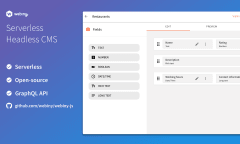
After several months of development, testing and iterations we are thrilled to announce the availability of Webiny Serverless Headless CMS (beta). It’s the first serverless headless CMS on the market that’s also open-source and self-hosted.

Memory-safe systems programming language Rust is finally capturing the attention of lots of developers.

The long-rumoured 8GB Raspberry Pi 4 is now available, priced at just $75.

Stack Overflow - The 2020 Developer Survey results are here!